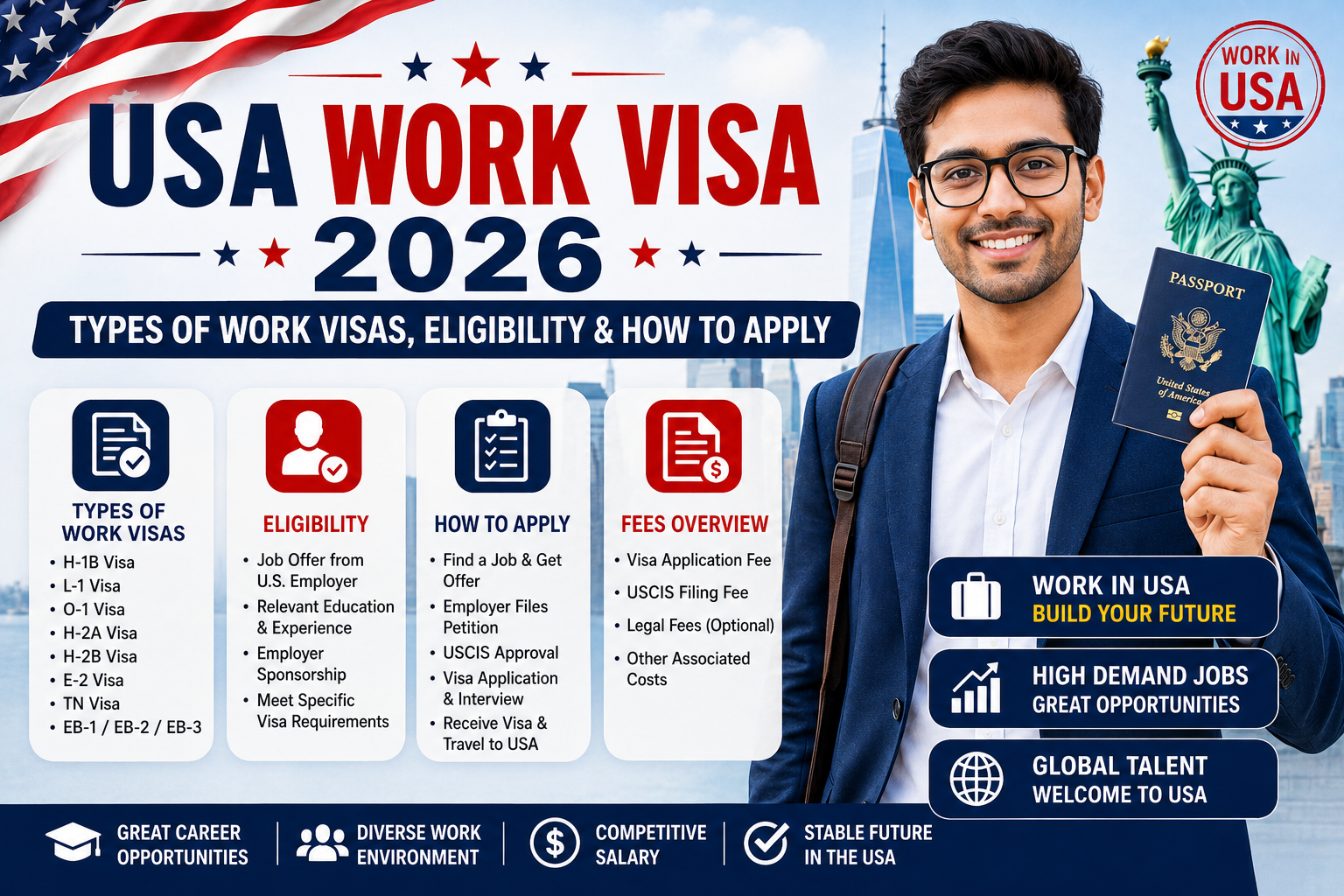
If you want to work legally in the United States in 2026, getting the right USA work visa is one of the most important steps. The United States offers several employment-based visa categories for foreign workers, and the correct visa depends on your occupation, qualifications, employer, nationality, type of employment and whether the job is temporary or permanent.
Popular U.S. work visa categories include H-1B, H-2A, H-2B, L-1, O-1, E-2, E-3 and certain employment-based immigrant visas. Each category has different eligibility requirements and application procedures.
For temporary employment, the U.S. Department of State explains that foreign workers must qualify for the available visa category based on the planned employment purpose. In many cases, the process begins before the visa application itself, often with an employer or other qualifying petitioner.
This complete guide explains the USA work visa types in 2026, eligibility requirements, employer sponsorship, application process, fees, processing considerations and how to find legitimate work opportunities in America.
Important: U.S. immigration rules can change. Always verify the current requirements with USCIS and the U.S. Department of State before applying.
What Is a USA Work Visa?
A U.S. work visa is an immigration document or status that allows an eligible foreign national to enter or remain in the United States for authorized employment.
There is no single visa called the “USA Work Visa.” Instead, the United States has multiple employment-related immigration categories.
Some visas are designed for:
- Highly skilled professionals
- Temporary agricultural workers
- Seasonal non-agricultural workers
- Employees transferring within multinational companies
- Individuals with extraordinary ability
- Treaty investors and certain treaty traders
- Australian specialty occupation professionals
- Permanent employment-based immigrants
The appropriate category depends on the worker’s specific circumstances.
Main Types of USA Work Visas in 2026
The following are some of the most important U.S. employment-related visa categories.
1. H-1B Visa
The H-1B visa is one of the best-known U.S. work visa categories.
It is designed for qualifying foreign workers performing services in specialty occupations. USCIS describes H-1B classification as applying to people who wish to perform services in a specialty occupation, including certain services of exceptional merit and ability.
Common H-1B fields include:
- Software engineering
- Information technology
- Data science
- Artificial intelligence
- Cybersecurity
- Engineering
- Finance
- Accounting
- Architecture
- Research
- Certain healthcare professions
A U.S. employer generally plays a central role in the H-1B petition process.
Who may qualify?
Generally, the worker needs to meet the requirements for the specialty occupation, often through an appropriate bachelor’s degree or equivalent qualifications.
The position itself must also satisfy the applicable H-1B requirements.
H-1B cap
Many H-1B positions are subject to an annual numerical cap. There are also categories and employers that may qualify for cap-exempt treatment under applicable rules.
Because demand can exceed the available numbers, some cap-subject H-1B cases involve an electronic registration and selection process.
2. H-2A Visa
The H-2A visa is designed for temporary agricultural workers.
U.S. agricultural employers may use the H-2A program when they need temporary agricultural labor and meet the program requirements.
Potential jobs can include:
- Farm workers
- Crop workers
- Harvest workers
- Nursery workers
- Agricultural laborers
- Seasonal farm positions
USCIS identifies H-2A as the temporary agricultural worker program.
The program has specific employer, recruitment, wage and worker requirements.
3. H-2B Visa
The H-2B visa is designed for certain temporary non-agricultural workers.
It can be used for eligible temporary employment in industries such as:
- Hospitality
- Resorts
- Landscaping
- Tourism
- Seasonal services
- Certain construction-related work
- Food service
- Other temporary labor
USCIS explains that the H-2B program allows U.S. employers to bring foreign workers to the United States to fill temporary non-agricultural jobs.
H-2B visas are subject to statutory limits, although Congress and the administration may authorize additional numbers under specific circumstances.
4. L-1 Visa
The L-1 visa is designed for certain employees of multinational companies.
It can be relevant when a company has qualifying operations in both the United States and another country and wants to transfer an eligible employee to its U.S. operation.
There are two major L-1 classifications:
L-1A
Generally for:
- Executives
- Managers
L-1B
Generally for employees with:
- Specialized knowledge
An L-1 applicant generally needs to have worked for the qualifying foreign organization for the required period before the transfer, subject to the applicable rules.
This visa can be particularly useful for employees of international companies expanding or transferring personnel to the United States.
5. O-1 Visa
The O-1 visa is for individuals who have extraordinary ability or achievement in qualifying fields.
Potential fields include:
- Sciences
- Education
- Business
- Athletics
- Arts
- Motion pictures
- Television
Applicants generally need extensive evidence demonstrating that they meet the applicable extraordinary-ability standards.
This is not a normal entry-level work visa. It is generally aimed at individuals with a strong record of professional achievement.
6. E-3 Visa
The E-3 visa is specifically available to qualifying nationals of Australia who will work in specialty occupations in the United States.
It can be attractive to eligible Australian professionals because it is specifically designed for this group.
Applicants must meet the applicable requirements for E-3 classification, including the specialty occupation requirements.
7. E-2 Treaty Investor Visa
The E-2 visa is available to qualifying nationals of treaty countries who make a substantial investment in a U.S. enterprise and meet the requirements of the category.
It can be relevant to entrepreneurs and investors rather than traditional employees.
USCIS provides specific requirements for E-2 treaty investors.
Important factors include:
- Treaty-country nationality
- Qualifying investment
- Real and operating U.S. enterprise
- Substantial investment
- Control or direction of the enterprise
- Other applicable requirements
The E-2 category is not available to nationals of every country.
8. Employment-Based Green Card
If your goal is permanent employment in the United States, you may need to consider an employment-based immigrant visa rather than a temporary work visa.
USCIS explains that the United States makes approximately 140,000 employment-based immigrant visas available each fiscal year, including eligible workers and certain family members.
Major employment-based categories include:
- EB-1
- EB-2
- EB-3
- EB-4
- EB-5
These categories have different requirements.
For example, EB-3 includes certain:
- Skilled workers
- Professionals
- Other workers
USCIS provides specific eligibility requirements for EB-3 employment-based immigration.
USA Work Visa Eligibility Requirements
There is no universal eligibility checklist because each visa category has different requirements.
However, applicants may need to demonstrate some combination of:
- Valid passport
- Qualifying job offer
- Employer sponsorship
- Appropriate educational qualifications
- Relevant professional experience
- Required skills
- Appropriate occupation
- Employer eligibility
- Financial or investment requirements
- Evidence of extraordinary ability, where applicable
- Labor certification, where required
- Approved petition, where required
- Intention and immigration eligibility appropriate to the visa category
The exact requirements should be checked against the specific visa classification.
Do You Need a Job Offer for a USA Work Visa?
For many employer-sponsored temporary work categories, a qualifying U.S. employer is an important part of the process.
USCIS explains that a common way to work temporarily in the United States as a nonimmigrant is for a prospective employer to file a petition on the worker’s behalf.
However, not every employment-based category works exactly the same way.
For example:
- H-1B generally involves a U.S. employer
- H-2A involves a qualifying agricultural employer
- H-2B involves a qualifying temporary employer
- L-1 involves an eligible multinational company
- O-1 requires a qualifying petitioner
- E-2 can be based on investment rather than a traditional job offer
Therefore, you should identify the correct visa category before assuming that a normal job application is enough.
How to Apply for a USA Work Visa in 2026
The application process varies by visa category, but the general process can look like this.
Step 1: Identify the Correct Visa
First determine which visa category fits your situation.
For example:
Software Engineer → H-1B may be relevant
Seasonal Farm Worker → H-2A may be relevant
Seasonal Hotel Worker → H-2B may be relevant
Multinational Company Manager → L-1A may be relevant
Highly Accomplished Professional → O-1 may be relevant
Australian Specialty Occupation Professional → E-3 may be relevant
These are examples only; actual eligibility depends on the individual facts.
Step 2: Find an Eligible Employer or Sponsor
If the visa requires employer sponsorship, find a U.S. employer willing and able to sponsor you.
Search for:
- USA visa sponsorship jobs
- Work visa sponsorship USA
- H-1B sponsorship jobs
- H-2B sponsorship jobs
- H-2A farm jobs USA
- L-1 transfer opportunities
- Employer-sponsored jobs USA
- Green Card sponsorship jobs
Step 3: Receive a Job Offer
The employer may provide a formal job offer describing:
- Position
- Salary
- Location
- Duties
- Start date
- Employment conditions
Do not assume that a job offer automatically means you qualify for a visa.
Step 4: Employer Files the Required Petition
For many temporary work categories, the U.S. employer or qualifying petitioner must file the appropriate petition with USCIS.
The specific form and supporting documents depend on the visa category.
Step 5: Complete Department of Labor Requirements
Certain employment visa categories involve Department of Labor requirements.
These may include:
- Labor Condition Application
- Prevailing wage requirements
- Recruitment requirements
- Labor certification
- Worker protection requirements
The exact requirements depend on the visa.
Step 6: USCIS Reviews the Petition
USCIS may:
- Approve the petition
- Request additional evidence
- Deny the petition
Approval of a petition is not necessarily the same thing as issuance of a visa.
Step 7: Complete the Visa Application
If you are outside the United States and need a visa to travel to America, you generally complete the applicable Department of State visa process after the required petition stage, where applicable.
The U.S. Department of State provides employment visa information and explains that temporary workers must qualify for the relevant visa category based on the planned employment purpose.
Step 8: Attend the Visa Interview
Depending on your category and circumstances, you may be required to attend an interview at a U.S. embassy or consulate.
You may need:
- Passport
- Visa application confirmation
- Appointment confirmation
- Petition approval information
- Employment documents
- Educational records
- Supporting evidence
- Other documents required for your category
Always follow the specific instructions from the embassy or consulate handling your application.
Step 9: Enter the United States
A visa allows you to request admission to the United States; it does not by itself guarantee admission.
At the port of entry, U.S. Customs and Border Protection makes the admission decision.
Once admitted, you must comply with the conditions of your immigration status.
USA Work Visa Fees in 2026
Work visa costs vary significantly.
Possible expenses can include:
- USCIS petition fees
- Visa application fees
- Fraud prevention fees
- Labor certification costs
- Premium processing, if available and requested
- Attorney fees
- Medical examination
- Document translation
- Travel expenses
There is no single fee that applies to every USA work visa.
The correct amount depends on:
- Visa category
- Employer
- Petition type
- Applicant circumstances
- Whether premium processing is requested
- Whether additional government fees apply
Before submitting any payment, check the latest official fee information.
How Long Does a USA Work Visa Take?
Processing time varies according to:
- Visa category
- USCIS workload
- Employer petition
- Embassy or consulate workload
- Applicant’s country
- Security checks
- Additional-document requests
- Administrative processing
Some cases may move relatively quickly, while others can take significantly longer.
The U.S. Department of State also publishes visa-related processing and appointment information, while USCIS provides processing information for petitions under its jurisdiction.
Applicants should avoid relying on unofficial websites that promise a guaranteed processing time.
USA Work Visa for Indians
Indian professionals frequently search for U.S. work opportunities in areas such as:
- Software development
- IT
- Engineering
- Data science
- Artificial intelligence
- Healthcare
- Finance
- Consulting
- Research
However, being an Indian citizen does not automatically qualify someone for a U.S. work visa.
The applicant must meet the requirements of the relevant category.
For employment-based immigrant visas, country-specific numerical limits and Visa Bulletin dates can also become important.
The Department of State publishes the monthly Visa Bulletin showing employment-based immigrant visa availability.
USA Work Visa for Freshers
Fresh graduates can potentially qualify for certain U.S. employment routes, but sponsorship is not guaranteed.
A fresher’s chances may depend on:
- Degree
- Occupation
- Employer
- Job requirements
- Visa category
- Relevant experience
- Cap availability
- Immigration status
For example, a computer science graduate may look for entry-level software positions with employers that consider international candidates.
However, applicants should not assume that every U.S. company sponsors fresh graduates.
High-Demand USA Jobs With Visa Sponsorship
Some occupations are commonly associated with employer-sponsored immigration opportunities.
Technology
- Software Engineer
- AI Engineer
- Machine Learning Engineer
- Data Scientist
- Cloud Engineer
- DevOps Engineer
- Cybersecurity Engineer
- Database Administrator
Engineering
- Mechanical Engineer
- Electrical Engineer
- Civil Engineer
- Chemical Engineer
- Industrial Engineer
Healthcare
- Registered Nurse
- Medical Researcher
- Healthcare Specialist
- Medical Technologist
- Pharmaceutical Professional
Healthcare workers should remember that immigration eligibility and professional licensing are separate issues.
Business and Finance
- Financial Analyst
- Accountant
- Business Analyst
- Risk Analyst
- Management Consultant
Seasonal Jobs
Depending on the applicable program:
- Farm worker
- Harvest worker
- Hotel worker
- Resort worker
- Landscaping worker
- Seasonal hospitality worker
How to Find USA Visa Sponsorship Jobs
Finding a legitimate sponsor is one of the most important steps.
Search Company Career Pages
Look at the official career pages of U.S. companies.
Search terms include:
Visa sponsorship available
H-1B sponsorship
Work authorization sponsorship
Employment sponsorship
Green Card sponsorship
Use Job Search Keywords
Instead of searching only:
Software Engineer USA
try:
Software Engineer H-1B sponsorship USA
Instead of:
Farm jobs USA
try:
H-2A farm jobs USA
Instead of:
Hotel jobs USA
try:
H-2B hospitality jobs USA
This can make your search more targeted.
How to Avoid USA Work Visa Scams
Visa-related employment scams are a major concern.
Be cautious if someone promises:
- Guaranteed visa
- Guaranteed Green Card
- Guaranteed job
- Visa without qualifications
- Job without interview
- Very high salary with no experience
- Immediate visa approval
You should never assume a recruiter is legitimate just because they use a professional-looking website.
Check:
- Employer’s official website
- Company email domain
- Job posting
- Recruiter’s identity
- Employment contract
- Government records where applicable
- Immigration documentation
The U.S. Department of State also publishes rights and protections information for temporary workers, including protections relating to wages and workplace treatment.
Can You Work in the USA on a Tourist Visa?
Generally, a visitor visa is not a substitute for a work visa.
A person should not enter the United States as a tourist intending to perform unauthorized employment.
If you want to work in America, identify and obtain the appropriate immigration status or employment authorization before starting work.
Can a Work Visa Lead to a Green Card?
Some temporary workers may eventually pursue permanent residence, depending on their circumstances and eligibility.
For example, an H-1B worker may potentially be sponsored for an employment-based immigrant category.
Employment-based Green Card categories include:
- EB-1
- EB-2
- EB-3
- EB-4
- EB-5
USCIS provides information about permanent workers and employment-based immigration categories.
However, a temporary work visa does not automatically convert into a Green Card.
A separate immigration process is generally required.
USA Work Visa vs Green Card
| Feature | Work Visa | Employment-Based Green Card |
|---|---|---|
| Purpose | Temporary employment in many cases | Permanent residence |
| Duration | Depends on category | Permanent if approved |
| Employer involvement | Often required | Often required |
| Job-specific | Often | Depends on category |
| Family benefits | Depends on category | Eligible dependents may qualify |
| Permanent residence | Not automatic | Yes, if approved |
Documents Required for a USA Work Visa
The documents depend on the visa category, but applicants may need:
- Valid passport
- Visa application form
- Passport photographs
- Job offer
- Employment contract
- Petition approval information
- Educational certificates
- University transcripts
- Professional licenses
- Work experience letters
- Resume
- Employer documents
- Financial documents where applicable
- Evidence supporting visa eligibility
- Previous immigration records
Do not submit unnecessary or false documents.
False statements or fraudulent documentation can have serious immigration consequences.
USA Work Visa Checklist 2026
Before starting your application, consider the following checklist:
Personal
- Valid passport
- Educational documents
- Work experience records
- Resume
- Professional certifications
Employment
- U.S. job offer
- Employer information
- Job description
- Salary information
- Work location
Immigration
- Correct visa category
- Petition, if required
- Labor certification or LCA, if required
- Visa application
- Interview documents
Financial
- Government fees
- Travel costs
- Medical costs, where applicable
- Attorney fees, if applicable
Important 2026 Visa Updates
U.S. immigration policy is changing regularly, so applicants should check official sources before applying.
The Department of State’s 2026 visa news page lists several recent developments involving visa services, screening and vetting, immigrant visa processing and other policy changes.
Employment-based immigrant visa availability can also change during the fiscal year. The Department of State publishes monthly Visa Bulletins showing employment-based visa availability and applicable dates.
For this reason, an article published in 2026 should not be treated as a permanent statement of immigration law.
Frequently Asked Questions
What is the easiest USA work visa?
There is no universally “easiest” U.S. work visa. The best option depends on your occupation, qualifications, employer, nationality and circumstances.
Which USA visa is best for skilled workers?
The H-1B is a major option for qualifying specialty occupations, while O-1, L-1, E-3 and employment-based immigrant categories may be relevant to specific applicants.
Can I get a USA work visa without a job offer?
Many employer-sponsored work visas require a qualifying employer or petitioner. Some categories have different structures, so eligibility depends on the specific visa.
Can Indians apply for a USA work visa?
Yes, Indian citizens can apply for U.S. work visa categories for which they qualify. Nationality alone does not guarantee approval.
Can I get a work visa after studying in the USA?
Some international students may transition to employment-based immigration options if they qualify and have the appropriate employment authorization and sponsorship.
How long is a USA work visa valid?
The validity period depends on the visa category and individual circumstances.
Can my family come with me?
Some work visa categories allow qualifying spouses and children to accompany or join the principal worker under dependent visa classifications.
Can I change employers after getting a work visa?
It depends on the visa category. Some employment visas allow employer changes through a new petition or other immigration process, while others are more restrictive.
Is a USA work visa guaranteed after getting a job offer?
No. A job offer does not guarantee visa approval.
Can I work in the USA without sponsorship?
Some people may have independent employment authorization or immigration categories that do not require traditional employer sponsorship. However, a person must have valid authorization to work.
Final Thoughts
Getting a USA Work Visa in 2026 can be an excellent opportunity for qualified international workers, but the correct immigration route depends on your individual circumstances.
The major options include:
- H-1B for qualifying specialty occupations
- H-2A for temporary agricultural work
- H-2B for temporary non-agricultural work
- L-1 for qualifying intracompany transfers
- O-1 for individuals with extraordinary ability
- E-3 for eligible Australian specialty-occupation professionals
- E-2 for qualifying treaty investors
- Employment-based immigrant visas for eligible permanent workers
For temporary employment, the U.S. Department of State emphasizes that the worker must qualify for the visa category based on the planned employment purpose, while USCIS explains that a prospective employer commonly files a petition for temporary employment.
The safest strategy is to choose the correct visa category first, find a legitimate employer or qualifying sponsor, understand the requirements, prepare accurate documentation and verify the latest rules through official U.S. government sources.
Do not pay an unknown person for a guaranteed U.S. visa or guaranteed job. There is no legitimate shortcut that guarantees approval.
Disclaimer: This article is intended for general educational and informational purposes only and does not constitute legal advice. U.S. immigration laws, fees, visa availability, processing procedures and eligibility requirements may change. Always check the latest information from USCIS and the U.S. Department of State or consult a qualified U.S. immigration attorney before making an immigration decision.